
Maurya Empire: History, Chandragupta Maurya and Ashoka
Maurya Empire: The Rise of Ancient India’s Greatest Empire The Maurya Empire was one of the largest and most influential empires in ancient Indian history. Founded…
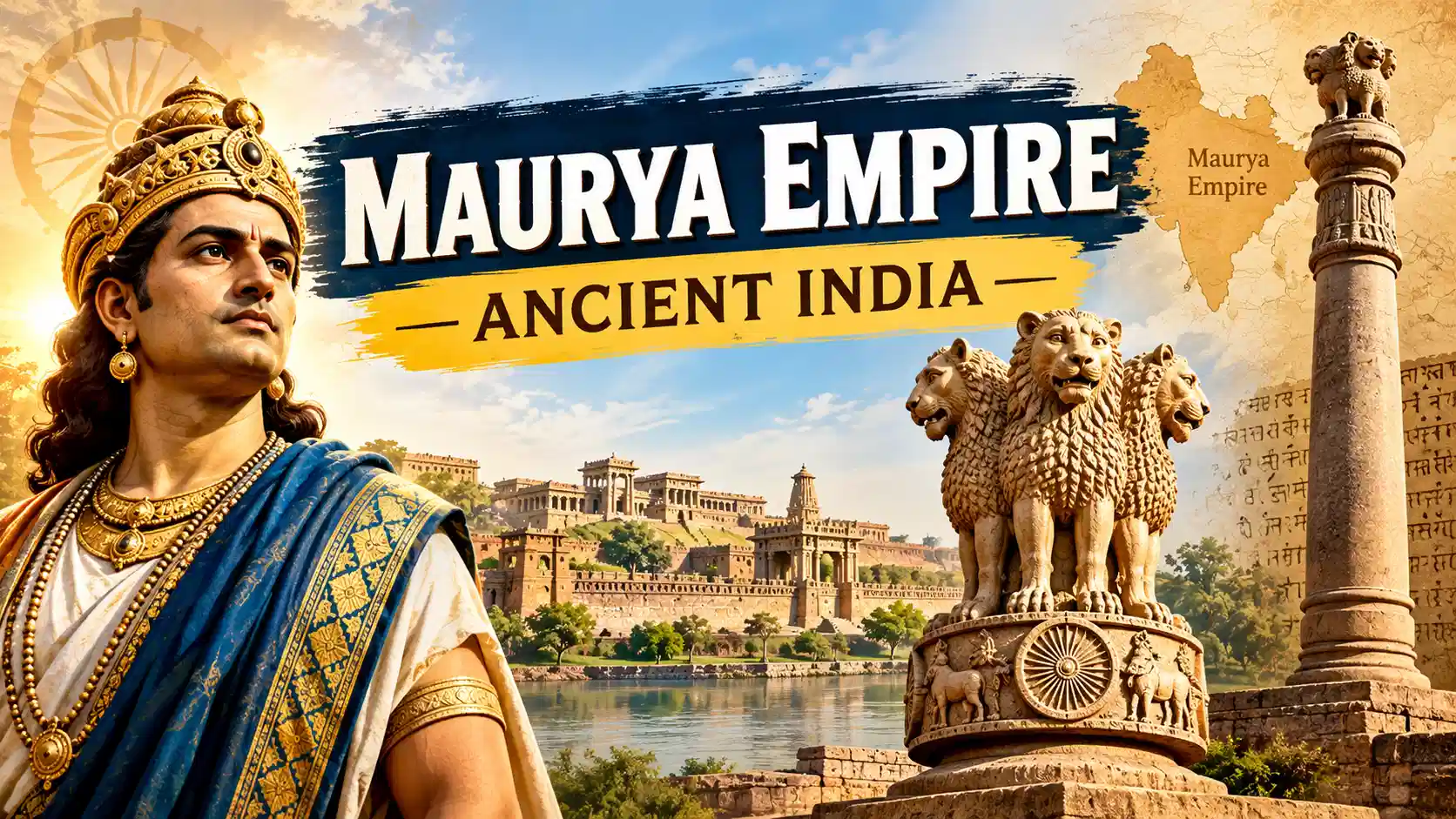
Maurya Empire: The Rise of Ancient India’s Greatest Empire
The Maurya Empire was one of the largest and most influential empires in ancient Indian history. Founded by Chandragupta Maurya in the fourth century BCE, the empire brought large parts of the Indian subcontinent under a centralised political system. It played a significant role in the development of administration, trade, diplomacy, art and religion.
The Maurya Empire reached its greatest territorial extent under Emperor Ashoka, who became one of the most famous rulers in Indian history. His support for Dhamma, public welfare and the spread of Buddhism made a lasting impact on India and other parts of Asia.
The history of the Maurya Empire is an important topic for students preparing for UPSC, APPSC, TGPSC and other competitive examinations.
Foundation of the Maurya Empire
The Maurya Empire was founded by Chandragupta Maurya around 322 BCE. Before its rise, the Nanda dynasty ruled the powerful kingdom of Magadha, with its capital at Pataliputra, present-day Patna in Bihar.
With the guidance traditionally associated with Chanakya, also known as Kautilya or Vishnugupta, Chandragupta overthrew the Nanda rulers and established the Maurya dynasty.
Chandragupta expanded his territories across northern India and later came into conflict with Seleucus I Nicator, one of the successors of Alexander the Great. Their agreement around 305–303 BCE helped establish relations between the Maurya Empire and the Seleucid Empire.
The Mauryas developed a powerful state that influenced political life across much of the subcontinent.
Chandragupta Maurya: The Founder
Chandragupta Maurya was the founder and first major ruler of the Maurya Empire. Through military campaigns, political alliances and administrative organisation, he established a strong imperial system.
His rule marked a significant turning point in ancient Indian history because several previously separate regions came under a larger political authority.
Pataliputra served as the imperial capital and became an important centre of administration and commerce. Greek accounts associated with Megasthenes, who visited the Mauryan court as an ambassador, provide valuable information about the empire, although his original work survives mainly through later quotations.
Chandragupta eventually abdicated the throne according to Jain traditions and is associated with the Jain teacher Bhadrabahu. These accounts connect his later life with Shravanabelagola in present-day Karnataka.
Bindusara: The Second Mauryan Emperor
Bindusara succeeded Chandragupta Maurya and continued to maintain and expand the empire. He ruled during the period between Chandragupta and Ashoka.
Ancient sources suggest that Bindusara maintained diplomatic connections with Hellenistic kingdoms. His reign helped preserve the strength of the Mauryan state and prepared the way for Ashoka’s later rule.
Although fewer details about Bindusara’s administration survive compared with those of Chandragupta and Ashoka, he played an important role in maintaining the continuity of the empire.
Ashoka: The Great Mauryan Emperor
Ashoka is regarded as one of the most remarkable rulers in Indian history. He expanded the Maurya Empire and is especially famous for the transformation in his political and moral outlook following the Kalinga War.
The Kalinga War, fought in the region of present-day Odisha, caused immense suffering. Ashoka’s own inscriptions describe his remorse over the loss of life and the suffering caused by the conquest.
Following the war, Ashoka increasingly promoted Dhamma, a moral policy emphasising respect for others, compassion, self-control, proper conduct and concern for living beings.
His inscriptions, carved on rocks and pillars across the empire, communicated royal messages to the public. They provide some of the most important direct historical evidence about his policies and beliefs.
Ashoka also supported Buddhist institutions and helped Buddhism gain wider recognition. Buddhist traditions associate his reign with efforts to spread the religion beyond India, although individual missionary accounts must be understood in their historical context.
Administration of the Maurya Empire
The Maurya Empire developed a sophisticated administrative system designed to govern extensive territories. The emperor stood at the centre of political authority, supported by officials responsible for revenue, security, justice and other functions.
The empire was divided into major territorial units, with officials and local authorities responsible for administration. Provincial centres helped the central government manage distant regions.
Agriculture was a major source of state revenue. Taxes, trade-related income and other levies supported the administration and military.
The Arthashastra, traditionally associated with Kautilya, discusses statecraft, economics, diplomacy, law and administration. However, scholars debate the text’s composition and development, so it should not be treated as a straightforward record of every policy implemented during Chandragupta’s reign.
Ashoka’s inscriptions offer additional evidence about officials, public responsibilities and the communication of royal policies.
Economy, Agriculture and Trade
Agriculture formed the foundation of the Mauryan economy. The fertile Gangetic plains supported farming and helped sustain large urban centres and the imperial administration.
Trade routes connected different regions of the empire, facilitating the movement of agricultural produce, textiles, metals, spices and other commodities. Roads and transport networks supported communication between administrative centres and commercial settlements.
Pataliputra became an important political and economic centre. The empire’s diplomatic contacts with Hellenistic kingdoms also connected it with wider commercial and cultural networks.
Coins, archaeological discoveries and ancient literary accounts help historians understand economic activity during the Mauryan period.
The Kalinga War and Ashoka’s Dhamma
The Kalinga War is one of the most significant events associated with Ashoka’s reign. In his Thirteenth Major Rock Edict, Ashoka expresses deep regret over the suffering caused by the conquest.
The experience influenced his approach to kingship and encouraged him to promote Dhamma as a guiding principle for social and moral conduct.
Ashoka’s Dhamma was not simply another name for Buddhism. It was a broader ethical policy that encouraged respect for parents and teachers, compassion towards living beings, generosity and tolerance among different religious communities.
He also emphasised the welfare of his subjects and appointed officials associated with promoting Dhamma.
Art and Architecture of the Maurya Empire
Mauryan art and architecture represent an important stage in the history of Indian artistic development.
The Ashokan pillars are among the best-known examples of Mauryan craftsmanship. These pillars were made from carefully polished stone and often carried inscriptions communicating royal policies.
The Lion Capital of Ashoka at Sarnath is particularly famous. Its four lions stand above a decorated abacus featuring animals and a wheel motif. The Lion Capital was adopted as India’s National Emblem, while the Ashoka Chakra appears at the centre of the Indian national flag.
The Barabar Caves in Bihar are among the earliest surviving examples of rock-cut architecture in India. Some caves were donated to the Ajivika religious community during Ashoka’s reign and that of his successor Dasharatha.
Buddhist stupas and other religious structures also developed during the Mauryan period, although many monuments were enlarged or modified in later centuries.
Spread of Buddhism
Ashoka played an important role in supporting Buddhism. He encouraged ethical conduct, sponsored religious establishments and supported efforts to communicate Buddhist teachings.
Buddhist traditions associate missions sent during his reign with the spread of Buddhism to Sri Lanka and other regions. The mission to Sri Lanka is traditionally linked with Mahinda, who is described as Ashoka’s son in Buddhist accounts.
The growth of Buddhism contributed to cultural exchanges between India and other Asian societies. Over subsequent centuries, Buddhist ideas, art and institutions spread across Central Asia, Southeast Asia and East Asia through different networks of monks, merchants and travellers.
Ashoka’s inscriptions remain especially important because they provide direct evidence of his interest in moral governance and religious tolerance.
Decline of the Maurya Empire
The Maurya Empire began to weaken after Ashoka’s death in approximately 232 BCE. Later rulers struggled to maintain control over the extensive territories inherited from their predecessors.
Regional powers gradually became more independent, while the central government lost some of its political and military strength.
In approximately 185 BCE, the last Mauryan ruler, Brihadratha, was killed by Pushyamitra Shunga, traditionally identified as his military commander. This event marked the end of the Maurya dynasty and the rise of the Shunga dynasty in much of its former heartland.
The decline of the Mauryas demonstrates the challenges involved in maintaining a large empire across diverse regions.
Important Historical Sources of the Maurya Empire
Historians study the Maurya Empire through inscriptions, archaeological evidence, literary works and foreign accounts.
Ashoka’s rock and pillar edicts provide direct evidence about royal policies, Dhamma and imperial communication. The Arthashastra offers insights into ancient Indian political thought and administration, although its composition developed over time.
Megasthenes’ account, known as the Indica, survives mainly through references by later writers. Buddhist and Jain traditions also preserve stories about Chandragupta, Ashoka and other figures associated with the period.
Together, these sources help reconstruct the political, economic and cultural history of the Maurya Empire.
Conclusion
The Maurya Empire transformed ancient Indian history by establishing a powerful political system across large parts of the subcontinent. Chandragupta Maurya laid its foundations, Bindusara maintained its strength, and Ashoka became famous for his inscriptions, moral policies and support for Buddhism.
The empire’s contributions to administration, diplomacy, art, architecture and religious history remain important today. From the Ashokan pillars to the spread of Buddhist traditions, the Maurya period continues to influence how we understand India’s ancient past.
Studying the Maurya Empire is essential for anyone interested in Indian history and preparing for competitive examinations such as UPSC, APPSC and TGPSC.
Frequently Asked Questions
1. Who founded the Maurya Empire?
Chandragupta Maurya founded the Maurya Empire around 322 BCE.
2. Who was the greatest ruler of the Maurya Empire?
Ashoka is widely regarded as one of its greatest rulers because of his imperial achievements, inscriptions and promotion of Dhamma.
3. What was the capital of the Maurya Empire?
Pataliputra, located near modern-day Patna in Bihar, was the imperial capital.
4. What was the importance of the Kalinga War?
The war caused immense suffering and influenced Ashoka to promote Dhamma and a more compassionate approach to governance.
5. Who wrote the Arthashastra?
The Arthashastra is traditionally attributed to Kautilya, also known as Chanakya or Vishnugupta.
6. What is the importance of Ashoka’s inscriptions?
They provide direct historical evidence about Ashoka’s policies, moral principles, administration and communication with his subjects.
7. Who was the last Mauryan ruler?
Brihadratha is generally identified as the last ruler of the Maurya dynasty.
8. When did the Maurya Empire end?
The Maurya dynasty ended around 185 BCE, when Brihadratha was overthrown by Pushyamitra Shunga.

1 Comment
Comments are closed.