Satavahana Dynasty: History, Kings, Administration, Art and Contributions
Satavahana Dynasty: History, Kings, Administration, Art and Contributions Introduction The Satavahana Dynasty was one of the most important ancient Indian dynasties that ruled large parts of…
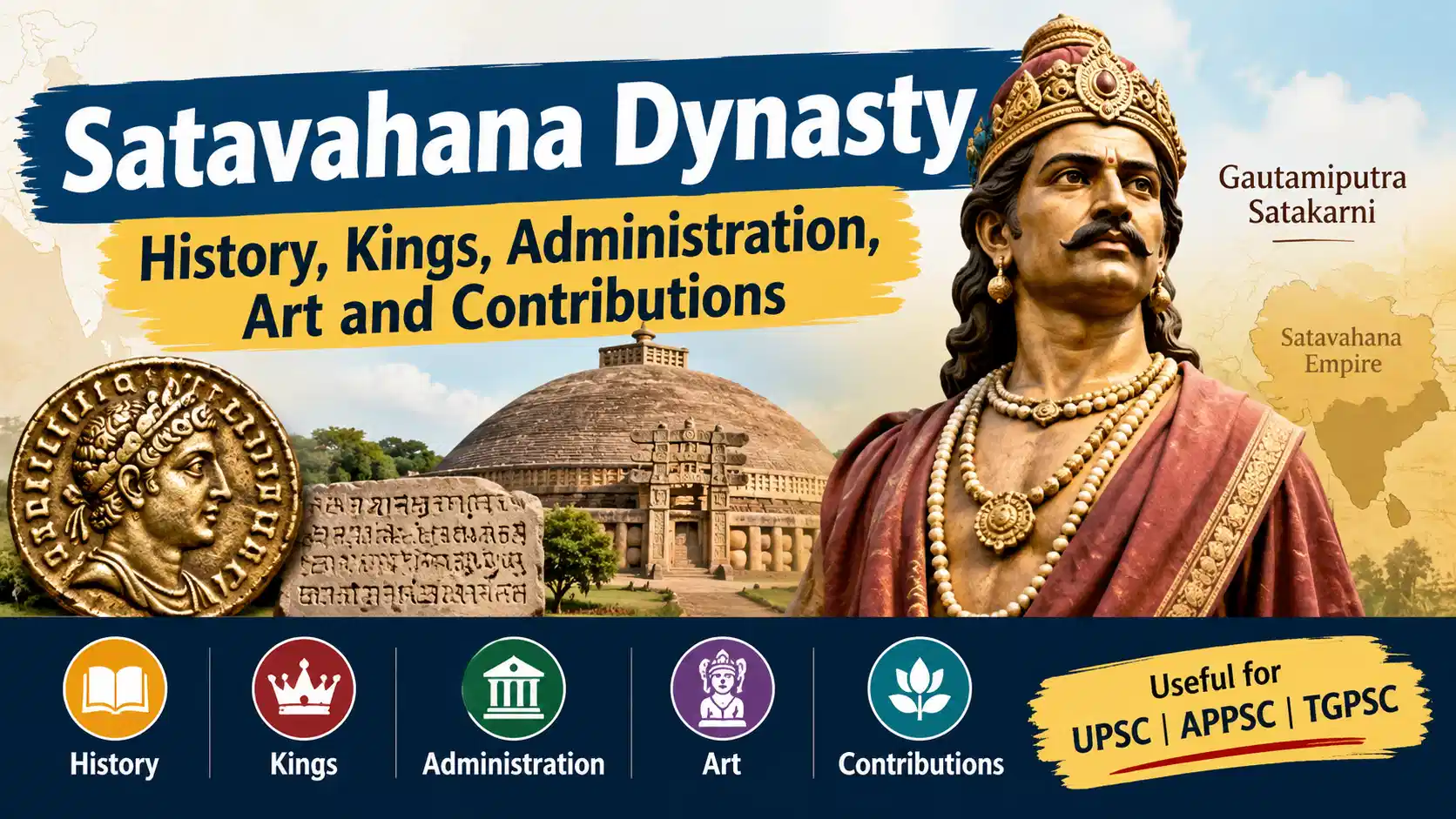
Satavahana Dynasty: History, Kings, Administration, Art and Contributions
Introduction
The Satavahana Dynasty was one of the most important ancient Indian dynasties that ruled large parts of the Deccan region. The Satavahanas played a significant role in the political, economic, cultural and religious development of ancient India. Their rule is particularly important in the history of present-day Andhra Pradesh, Telangana and Maharashtra.
The dynasty emerged after the decline of the Mauryan Empire and became a major political power in the Deccan. The Satavahanas promoted trade, supported religious institutions, encouraged artistic activities and maintained important connections with other parts of India and the Roman world.
For students preparing for competitive examinations such as UPSC, APPSC and TGPSC, the Satavahana Dynasty is an important topic in Ancient Indian History.
Origin and Establishment of the Satavahana Dynasty
The Satavahana Dynasty is generally associated with the period between the first century BCE and the third century CE, although the exact dates of its foundation and individual rulers remain debated among historians.
Simuka is traditionally regarded as the founder of the dynasty. According to historical traditions, he established Satavahana authority following the decline of the Kanva dynasty and the weakening of earlier political powers in northern India.
The Puranas refer to the Satavahanas using names such as Andhra and Andhrabhritya. Inscriptions and coins provide additional evidence about their rulers, territories and administration.
The dynasty initially established its influence in the Deccan and gradually expanded its political authority over several regions. Pratishthana, identified with modern Paithan in Maharashtra, was an important Satavahana capital.
Important Rulers of the Satavahana Dynasty
1. Simuka
Simuka is traditionally considered the founder of the Satavahana Dynasty. He established the foundation of the kingdom and helped consolidate its political position in the Deccan.
Although information about his reign is limited, his importance lies in establishing the ruling dynasty that later became a major power in ancient India.
2. Satakarni I
Satakarni I was one of the notable early Satavahana rulers. Historical evidence, particularly the Naneghat inscription associated with Queen Naganika, provides information about his military achievements and religious activities.
He expanded the kingdom’s influence into parts of western and central India. He is also associated with the performance of Vedic sacrifices, including the Ashvamedha.
The Naneghat inscription is an important source for understanding early Satavahana political history, royal ceremonies and family relationships.
3. Gautamiputra Satakarni
Gautamiputra Satakarni is widely regarded as one of the greatest rulers of the Satavahana Dynasty. He strengthened the kingdom and restored its power after conflicts with the Western Kshatrapas.
One of his major achievements was his victory over Nahapana, an important ruler of the Western Kshatrapas. Coins originally issued by Nahapana and subsequently restruck under Gautamiputra Satakarni provide valuable evidence of this political change.
The Nashik inscription issued by his mother, Gautami Balashri, describes his achievements and military reputation. It is one of the most significant sources for studying his reign.
His rule strengthened Satavahana authority across substantial parts of the Deccan and western India.
4. Vasisthiputra Pulumavi
Vasisthiputra Pulumavi succeeded Gautamiputra Satakarni and continued the dynasty’s political traditions.
Evidence from inscriptions and coins suggests that Satavahana influence remained significant during his reign. He is also associated with the continued development of trade and the maintenance of connections between inland settlements and coastal regions.
The period witnessed continued activity in religious architecture and the patronage of Buddhist establishments.
5. Yajna Sri Satakarni
Yajna Sri Satakarni was another important ruler, particularly known for efforts to recover territories from the Western Kshatrapas.
Coins associated with his reign include ship designs, which are often discussed in connection with maritime trade and commercial activity.
He is generally regarded as one of the later powerful Satavahana rulers. Following his period, the dynasty gradually lost political strength as regional powers became increasingly independent.
Administration of the Satavahana Dynasty
The Satavahanas maintained a monarchy supported by officials, subordinate rulers and local administrative authorities.
The king occupied the highest position in the political system and was responsible for military affairs, administration and the protection of the kingdom.
Local chiefs and subordinate rulers played important roles in governing different territories. Inscriptions also provide evidence of officials, land grants and administrative arrangements.
The kingdom’s political organisation allowed the rulers to exercise authority over geographically diverse regions. However, local powers retained influence in many areas.
Satavahana inscriptions are valuable sources for understanding the relationship between royal authority, local elites and religious institutions.
Economy, Agriculture and Trade
Agriculture formed an important foundation of the Satavahana economy. Farming communities produced agricultural goods that supported towns, settlements and commercial networks.
Trade also played a major role in the kingdom’s prosperity. The Satavahanas controlled or influenced important inland routes connecting the Deccan with western coastal ports and other commercial centres.
Merchants traded goods such as textiles, spices, precious stones and other commodities. Commercial connections extended to regions beyond the Indian subcontinent, including the Roman world.
Coins made from metals such as lead, copper and other materials provide evidence of monetary exchange and regional economic activity.
The growth of trade supported urbanisation, artisan communities and donations to religious establishments. Merchants and other donors contributed to the construction and maintenance of Buddhist caves, monasteries and stupas.
Religion and Religious Patronage
The Satavahana period witnessed the development and coexistence of different religious traditions.
Some rulers performed Vedic sacrifices and supported Brahmanical religious practices. At the same time, Buddhist institutions received donations from rulers, merchants, officials and other individuals.
Buddhist caves and monasteries at places such as Nashik, Karla and Bhaja preserve inscriptions documenting donations and religious activities.
This evidence demonstrates that religious patronage was not limited to a single group. Different communities contributed to the development of religious institutions and artistic traditions.
The Satavahana period is therefore important for understanding the relationship between political power, religion and society in ancient India.
Art and Architecture During the Satavahana Period
The Satavahana period contributed significantly to the development of Buddhist architecture and regional artistic traditions.
Important examples of Buddhist architectural activity include the cave complexes at Karla, Bhaja and Nashik. These sites contain rock-cut halls, monasteries and inscriptions associated with religious patronage.
The Amaravati Buddhist stupa tradition is also closely associated with the broader historical and cultural environment of the eastern Deccan during the Satavahana period and subsequent centuries.
Amaravati is particularly famous for its sculptural traditions, including narrative reliefs and representations connected with Buddhist themes.
The artistic developments of this period demonstrate the influence of religious beliefs, trade networks and donations from different sections of society.
Literature and Language
Prakrit was an important language used in Satavahana inscriptions. Many inscriptions were written in the Brahmi script, providing evidence about royal activities, social relationships and religious donations.
The Satavahana period is also associated with literary traditions. King Hala is traditionally linked with the Gatha Saptashati, a collection of verses in Maharashtri Prakrit.
The work is significant for the study of early Indian literature, poetry and social life. However, its compilation and literary history reflect a broader tradition rather than necessarily a single moment of composition.
The use of Prakrit in inscriptions and literature provides valuable insights into linguistic and cultural developments in ancient India.
Decline of the Satavahana Dynasty
The Satavahana Dynasty gradually declined during the third century CE. The exact chronology and sequence of the later rulers remain subjects of historical discussion.
Several factors contributed to the decline, including political conflicts, the weakening of central authority and the emergence of regional powers.
Following the decline of Satavahana authority, different dynasties and local ruling families expanded their influence across parts of the Deccan.
Although the dynasty eventually disappeared as a major political power, its administrative traditions, commercial connections and artistic contributions remained important in the history of the region.
Historical Sources of the Satavahana Dynasty
Historians reconstruct Satavahana history using several categories of evidence.
Inscriptions: The Naneghat inscription associated with Queen Naganika and the Nashik inscription associated with Gautami Balashri provide information about rulers, royal achievements and religious donations.
Coins: Satavahana coins help researchers understand political authority, economic activity, iconography and commercial connections.
Literary sources: The Puranas and other literary traditions preserve accounts of rulers and dynastic succession, although their chronological details sometimes differ.
Archaeological evidence: Buddhist caves, stupas, sculptures and other remains help explain religious patronage, artistic traditions and urban development.
Combining these sources allows historians to develop a more reliable understanding of the dynasty while recognising that some details remain uncertain.
Importance of the Satavahana Dynasty for Competitive Exams
The Satavahana Dynasty is an important topic for Ancient Indian History in UPSC, APPSC and TGPSC examinations.
Students should focus on the following key points:
- Simuka is traditionally regarded as the founder of the dynasty.
- Pratishthana, modern Paithan, was an important Satavahana capital.
- Satakarni I is associated with the Naneghat inscription and Vedic sacrifices.
- Gautamiputra Satakarni defeated Nahapana of the Western Kshatrapas.
- Gautami Balashri’s Nashik inscription is an important historical source.
- Vasisthiputra Pulumavi and Yajna Sri Satakarni were notable later rulers.
- Prakrit and the Brahmi script were important in Satavahana inscriptions.
- Trade, Buddhist architecture, coinage and religious donations were significant features of the period.
Conclusion
The Satavahana Dynasty occupies an important place in the history of ancient India. Its rulers strengthened political authority in the Deccan, encouraged commercial activity and supported religious and artistic institutions.
The dynasty’s inscriptions, coins, literature and architectural remains continue to provide valuable evidence about ancient Indian society. For students and history enthusiasts, studying the Satavahanas helps explain the political and cultural development of the Deccan and its connections with the wider ancient world.
Understanding the Satavahana Dynasty is essential for gaining a broader perspective on Ancient Indian History and preparing effectively for competitive examinations.
Frequently Asked Questions (FAQs)
1. Who founded the Satavahana Dynasty?
Simuka is traditionally regarded as the founder of the Satavahana Dynasty.
2. What was the capital of the Satavahana Dynasty?
Pratishthana, identified with modern Paithan in Maharashtra, was an important Satavahana capital.
3. Who was the greatest ruler of the Satavahana Dynasty?
Gautamiputra Satakarni is widely regarded as one of its greatest rulers.
4. Which inscription provides information about Satakarni I?
The Naneghat inscription associated with Queen Naganika provides important information about Satakarni I.
5. Why is Gautamiputra Satakarni famous?
He is known for strengthening Satavahana power and defeating Nahapana of the Western Kshatrapas.
6. Which language was used in Satavahana inscriptions?
Prakrit was widely used, and many inscriptions were written in the Brahmi script.
7. Why is the Satavahana Dynasty important in Indian history?
It played a significant role in the political, economic, religious and cultural development of the Deccan.
8. Which competitive examinations include the Satavahana Dynasty?
The topic is relevant to Ancient Indian History sections of UPSC, APPSC, TGPSC and other state public service examinations.