Gupta Empire: The Golden Age of Ancient India
Gupta Empire: The Golden Age of Ancient India The Gupta Empire occupies a remarkable place in the history of ancient India. Known for its achievements in…
Gupta Empire: The Golden Age of Ancient India
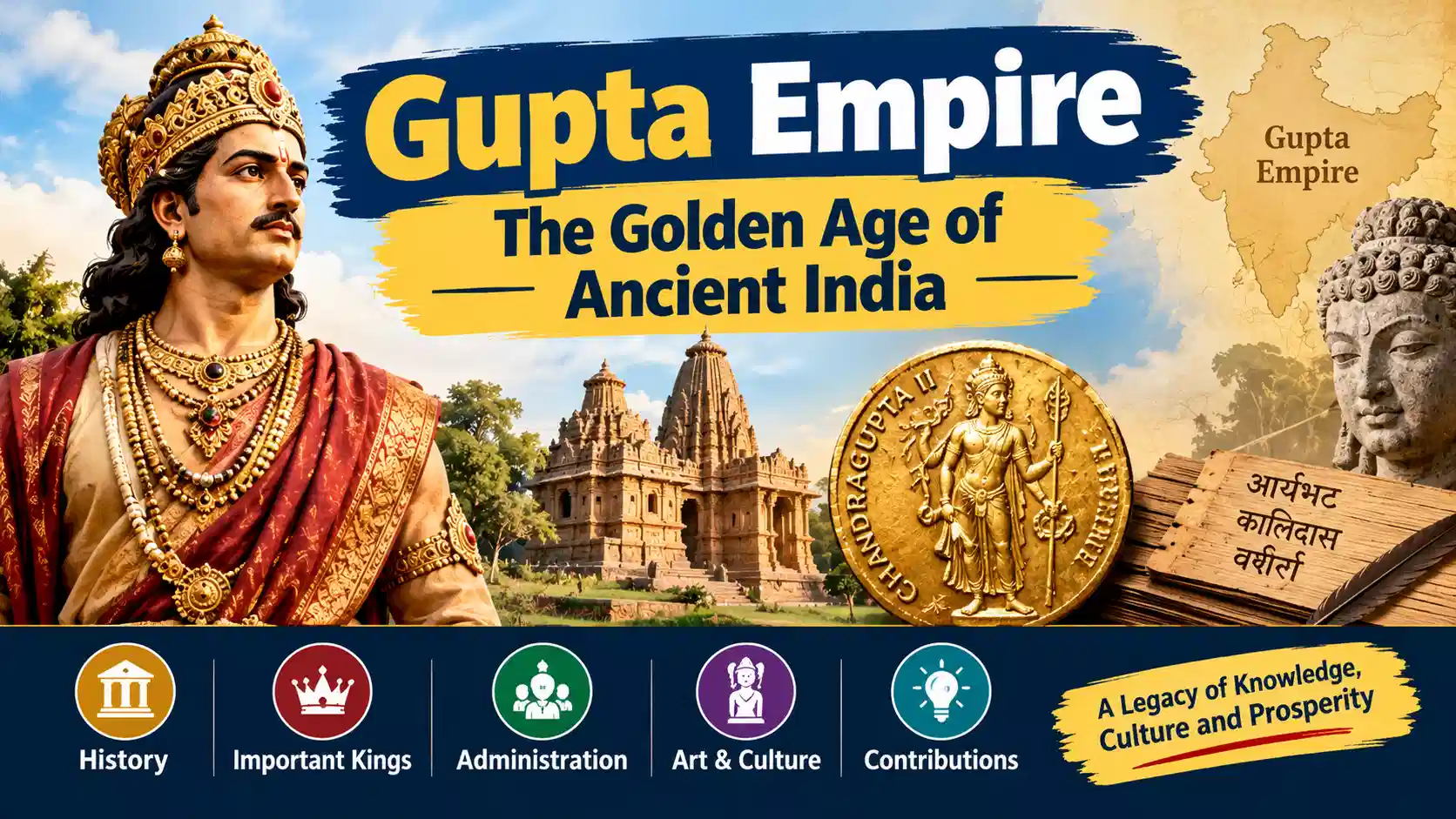
The Gupta Empire occupies a remarkable place in the history of ancient India. Known for its achievements in literature, science, mathematics, art, architecture and culture, the Gupta period is often described as the Golden Age of Ancient India. The empire reached its greatest prominence during the fourth and fifth centuries CE, when powerful rulers expanded their territories and encouraged cultural and intellectual development.
The Gupta Empire played a significant role in shaping India’s historical and cultural heritage. Its contributions continue to be studied by historians and students preparing for competitive examinations such as UPSC, APPSC and TGPSC.
Origin and Rise of the Gupta Empire
The Gupta dynasty emerged in northern India around the late third century CE. Sri Gupta is generally regarded as the earliest known ruler of the dynasty, while his successor Ghatotkacha continued to strengthen the family’s position.
The real expansion of the empire began under Chandragupta I, who ruled in the early fourth century CE. His marriage to Kumaradevi, a princess of the Licchavi family, is considered an important political alliance that strengthened the dynasty’s influence.
Chandragupta I adopted the title Maharajadhiraja, meaning King of Kings. Under his leadership, the Guptas began to emerge as a major political power in northern India.
Samudragupta: The Great Conqueror
Samudragupta was one of the most powerful rulers of the Gupta Empire. He expanded the kingdom through military campaigns and established political influence over several regions of the Indian subcontinent.
Much of what historians know about his achievements comes from the Allahabad Pillar Inscription, also known as the Prayaga Prashasti. It was composed by his court poet Harisena and describes his military campaigns, political achievements and royal qualities.
Samudragupta defeated several rulers in northern India and conducted campaigns in the south. Rather than directly annexing every southern kingdom, he allowed many defeated rulers to retain their territories under conditions of submission.
Samudragupta was also known for his interest in music and culture. Some of his coins depict him playing a veena, suggesting his association with artistic pursuits.
His reign significantly strengthened the political position of the Gupta dynasty.
Chandragupta II and the Expansion of the Empire
Chandragupta II, also known as Vikramaditya, was another important ruler of the Gupta Empire. He further expanded the empire and strengthened its political and economic position.
One of his major achievements was the defeat of the Western Kshatrapas, who controlled important regions of western India. This victory improved Gupta access to western trade routes and commercial centres.
During his reign, the empire experienced significant cultural development. Sanskrit literature, art and religious traditions flourished, and the Gupta court became associated with intellectual and artistic activity.
The Chinese Buddhist traveller Faxian visited India during Chandragupta II’s reign. His travel account provides valuable information about society, religious institutions and conditions in parts of northern India at that time.
Administration of the Gupta Empire
The Gupta Empire followed a monarchical system of government. The king held the highest authority and was responsible for administration, military affairs and the protection of the kingdom.
The empire was divided into administrative units governed by officials and local authorities. Provinces, districts and villages formed important parts of the administrative structure, although terminology and arrangements varied across regions and periods.
Local chiefs, landholders and influential families also played important roles in administration. In some areas, rulers exercised direct control, while other territories maintained a degree of local autonomy.
The Gupta rulers issued land grants to religious institutions and individuals. These grants provide important historical evidence about land ownership, taxation, local administration and the changing relationship between kings and local authorities.
Science and Mathematics During the Gupta Period
The Gupta period is especially remembered for developments in mathematics and astronomy. Indian scholars made important contributions to numerical systems, mathematical calculations and the study of celestial movements.
Aryabhata, one of India’s most celebrated mathematicians and astronomers, composed the Aryabhatiya in 499 CE. He explained mathematical methods and astronomical concepts, including the rotation of the Earth on its axis and methods for calculating eclipses.
Indian mathematical traditions developed the decimal place-value system and the use of zero over a longer historical process. These achievements should not be attributed exclusively to one ruler or a single period, but the Gupta age formed an important part of this intellectual history.
Astronomy, mathematics and related fields influenced later Indian scholarship and contributed to the transmission of knowledge beyond the subcontinent.
Literature and Sanskrit Language
Sanskrit literature flourished during the Gupta period. Royal courts and learned communities supported literary activity, and Sanskrit became an important language of political expression, scholarship and artistic writing.
Kalidasa is one of the most celebrated literary figures associated with the classical Sanskrit tradition. His works include Abhijnanashakuntalam, Meghaduta and Raghuvamsha.
These literary works are admired for their poetic language, dramatic structure and descriptions of nature, human relationships and royal life.
The development of Sanskrit literature during this period had a lasting influence on Indian literary traditions. However, the precise dates of individual authors and works are not always certain, and not every celebrated Sanskrit writer can be definitively placed within the reign of a particular Gupta ruler.
Art and Architecture of the Gupta Empire
The Gupta period is widely recognised for its achievements in sculpture, temple architecture and religious art. Artists developed refined styles that influenced later Indian artistic traditions.
Sculptures associated with this period often display balanced proportions, detailed craftsmanship and a sense of calm expression. Hindu, Buddhist and Jain artistic traditions all developed during this broader historical period.
The Dashavatara Temple at Deogarh is an important example of early Hindu temple architecture associated with the Gupta age. Its design and sculptural decoration illustrate developments in temple construction.
Buddhist art also flourished at important centres such as Sarnath. Sculptures from Sarnath are known for their elegant forms and refined treatment of Buddhist themes.
The Ajanta caves contain remarkable paintings and sculptures created across several phases. Some of their most celebrated later paintings date to the fifth century CE and are associated with the cultural environment of the Vakataka period, which was contemporary with the Guptas.
These artistic achievements demonstrate the richness and diversity of ancient Indian culture.
Religion During the Gupta Period
Hindu religious traditions received substantial royal patronage during the Gupta period. Several rulers worshipped Hindu deities, and inscriptions and temples provide evidence of the development of Vaishnavism and Shaivism.
At the same time, Buddhism and Jainism continued to flourish in different regions. Religious institutions received donations from rulers, merchants and other members of society.
The coexistence of different religious traditions contributed to the cultural diversity of the period. Religious beliefs influenced sculpture, architecture, literature and everyday social practices.
The Gupta period therefore provides important evidence for understanding the development of religious traditions in ancient India.
Economy, Agriculture and Trade
Agriculture formed the foundation of the Gupta economy. Rural communities produced crops that supported towns, royal administrations and local markets.
Trade and craft production also contributed to economic activity. Artisans produced textiles, metal goods, pottery, jewellery and other products for local use and commercial exchange.
Coins issued by Gupta rulers, particularly gold coins, provide evidence of royal authority, economic transactions and artistic traditions. Their inscriptions and images also help historians study the titles and achievements of different rulers.
However, the prosperity of the empire was not uniform across every region or social group. Economic conditions varied, and the benefits of political stability and commercial activity were not necessarily shared equally by the entire population.
Why Is the Gupta Period Called the Golden Age of India?
The Gupta period is often called the Golden Age of Ancient India because of its achievements in several fields.
Literature developed significantly, particularly in Sanskrit. Mathematics and astronomy advanced through the work of scholars such as Aryabhata. Sculpture and temple architecture reached important stages of development, while religious institutions and artistic communities received patronage.
Political stability under powerful rulers also helped create favourable conditions for cultural activity in many parts of the empire.
Nevertheless, historians recognise that the term Golden Age is a broad historical description. The period was not equally prosperous for every community, and social inequalities remained. The label primarily reflects important achievements in culture, scholarship and the arts rather than suggesting that every aspect of society was ideal.
Decline of the Gupta Empire
The Gupta Empire gradually weakened during the fifth and sixth centuries CE. Several factors contributed to its decline, including succession disputes, regional independence movements and military pressures.
The invasions of the Hunas, particularly during the later fifth and early sixth centuries, placed considerable pressure on Gupta authority. Some rulers resisted these invasions, but maintaining control over the extensive empire became increasingly difficult.
As central authority weakened, regional rulers established or expanded their own kingdoms. The empire fragmented, and the Guptas eventually lost their position as a dominant power across northern India.
Although the political empire declined, its contributions to literature, mathematics, art and architecture continued to influence later generations.
Important Gupta Rulers to Remember
Sri Gupta is generally regarded as the earliest known ruler of the dynasty. Chandragupta I laid the foundation for imperial expansion. Samudragupta greatly extended Gupta political influence, while Chandragupta II strengthened the empire and contributed to its cultural prominence.
Later rulers, including Kumaragupta I and Skandagupta, also played important roles in maintaining the empire. Skandagupta is particularly associated with resistance to Huna incursions.
The achievements of these rulers, together with the work of scholars, artists, religious institutions and local communities, shaped the historical significance of the Gupta period.
Conclusion
The Gupta Empire remains one of the most important chapters in ancient Indian history. Its rulers established a powerful political system, while scholars, poets, artists and religious communities contributed to significant developments in knowledge and culture.
From Aryabhata’s mathematical and astronomical work to Kalidasa’s literary achievements and the refined sculptures of the period, the Gupta age left a lasting mark on India’s heritage.
Although the term Golden Age should be understood with historical care, the Gupta period undeniably represents a major phase in the development of Indian civilisation. Studying this empire helps us understand the political, cultural and intellectual foundations of ancient India.
Frequently Asked Questions
1. Who founded the Gupta Empire?
Sri Gupta is generally regarded as the earliest known ruler of the Gupta dynasty, while Chandragupta I established the foundations of its imperial expansion.
2. Who was the greatest ruler of the Gupta Empire?
Samudragupta and Chandragupta II are widely regarded as two of the most important Gupta rulers.
3. Why is the Gupta period called the Golden Age of India?
It is known for major achievements in literature, mathematics, astronomy, sculpture, temple architecture and cultural development.
4. Who was Aryabhata?
Aryabhata was a renowned Indian mathematician and astronomer who composed the Aryabhatiya in 499 CE.
5. Who wrote Abhijnanashakuntalam?
The classical Sanskrit playwright and poet Kalidasa wrote Abhijnanashakuntalam.
6. Which inscription provides information about Samudragupta?
The Allahabad Pillar Inscription, also known as the Prayaga Prashasti, composed by Harisena, provides important information about Samudragupta.
7. What caused the decline of the Gupta Empire?
Political fragmentation, succession problems, regional independence and Huna invasions contributed to its decline.
8. Which competitive examinations include the Gupta Empire?
The Gupta Empire is an important topic in Ancient Indian History for UPSC, APPSC, TGPSC and other state-level competitive examinations.